

Sylvester Stallone does not need an invented honor to prove that his influence has lasted.
A claim circulating online says the actor was named to TIME’s 2026 list of the world’s 100 most influential people. The official TIME100 list does not include Stallone, and TIME itself calls the annual feature the “100 Most Influential People,” not the “100 Most Powerful People.”
The real story, however, may be more interesting than the viral headline.
Nearly 50 years after Rocky turned an unknown actor and writer into an international star, Stallone remains one of the rare Hollywood figures whose characters have become larger than the films that introduced them.
Rocky Balboa became a symbol of the underdog.
John Rambo became one of the defining action characters of the 1980s.

And Stallone himself became something increasingly difficult to achieve in Hollywood: an actor whose name could represent an entire style of filmmaking.
His path to that position was anything but guaranteed.
Stallone’s official biography says that by 1973 he had auditioned repeatedly around New York with little success. He increasingly turned to writing while waiting for an acting breakthrough, eventually landing a more substantial role in The Lords of Flatbush. Even after moving to Hollywood, the major roles he wanted did not immediately appear.
Then came Rocky.
Stallone wrote the screenplay himself and insisted on playing the title role even when producers interested in the script considered using a more established actor. That decision became the turning point not only of his career, but of the public story that would follow him for decades.
When Rocky reached theaters in 1976, it became far more than a boxing movie.
At the 49th Academy Awards, the film received nine nominations and won three Oscars, including Best Picture, Best Director for John G. Avildsen and Best Film Editing. Stallone was nominated both as Best Actor and for his original screenplay. The Academy notes that he became only the third person in Oscar history at that time to receive acting and screenwriting nominations in the same year.
That achievement changed the way audiences saw Stallone.
He was no longer simply an actor with an unusual voice and an imposing physical presence.

He was also the writer who had created the character that made him famous.
That distinction would follow him throughout his career.
Stallone continued writing, directing and producing while expanding the world of Rocky through multiple sequels. At the same time, First Blood introduced audiences to John Rambo, another character who would become inseparable from his public identity.
Rocky and Rambo were very different men.
Rocky was vulnerable, romantic and often uncertain.
Rambo was isolated, traumatized and dangerous.
But both characters shared something audiences repeatedly associated with Stallone: survival.
They could be damaged.
They could lose.
They could age.
But they continued.
That theme eventually became part of Stallone’s own career.
The enormous success of the 1970s and 1980s did not last without interruption. Some later films disappointed. The kinds of action movies that had made Stallone a superstar changed. Younger performers arrived. Hollywood itself moved into a different era.
Stallone had to reinvent himself.

One of the most important moments came when he returned to Rocky Balboa in Creed.
This time, Stallone was no longer playing the young underdog demanding his opportunity.
Michael B. Jordan’s Adonis Creed was the fighter.
Rocky was older, more fragile and forced to confront illness, grief and the limits of his own body.
The role gave Stallone another Academy Award nomination in 2016 — nearly four decades after his first Best Actor nomination for playing the same character.
That kind of longevity is unusual.
Most actors eventually move away from the characters that made them famous.
Stallone did something different.
He allowed Rocky to age with him.
The result gave audiences a rare chance to watch the meaning of a character change across generations.
The young Rocky was trying to prove that he mattered.
The older Rocky was learning how to live after many of the people and ambitions that once defined him were gone.
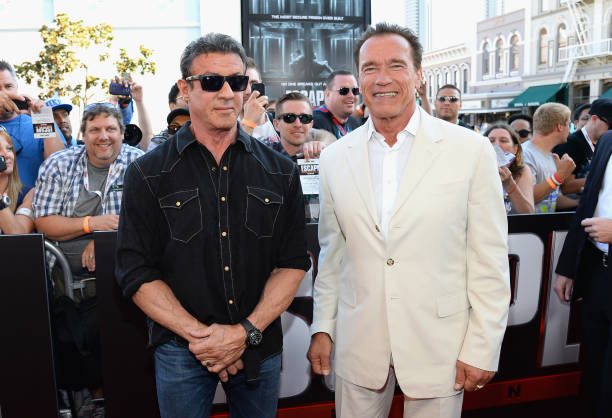
Stallone’s influence also expanded beyond those two franchises.
He wrote, directed and starred in The Expendables, assembling performers including Jason Statham, Jet Li, Dolph Lundgren, Mickey Rourke, Bruce Willis and Arnold Schwarzenegger. His official biography describes the project as one of his most ambitious efforts and notes that the film opened at No. 1 at the box office.
The idea behind The Expendables was almost a statement about Stallone’s own generation.
Hollywood had changed.
Its veteran action stars were older.
But Stallone built a movie around the proposition that audiences still wanted to see them.
In some ways, it was another version of the idea behind Rocky.
Do not assume someone is finished simply because the industry has moved on.
That may explain why Stallone’s appeal has lasted beyond individual films.
His career has always contained contradictions.
He is associated with muscles, yet his most famous character succeeds because of heart.
He became an action icon, yet his breakthrough came from writing.
He built a career around physical strength, then received one of his strongest later-career responses for playing an aging man confronting weakness.
And while his films often celebrate winning, Rocky’s original lesson was never really about victory.
It was about going the distance.
That is why Stallone’s cultural position cannot be reduced to one magazine list or one award.

TIME’s 2026 list does not include him.
But Rocky won Best Picture almost half a century ago, Stallone was nominated by the Academy again for Creed decades later, and the characters he created remain immediately recognizable across generations.
The more meaningful measure of Stallone’s influence may be simpler.
People who were not alive when Rocky premiered still recognize the music.
They know the steps.
They know the raised fists.
They know Rambo.
And they understand what someone means when a struggling outsider is compared to Rocky Balboa.
Awards can recognize influence.
Lists can document it.
But few actors ever create characters that escape the screen and become part of the language people use to understand struggle itself.
Sylvester Stallone did that.
And nearly five decades later, that may be the achievement that matters most.


