

HOMECOMING IN METAL AND MEMORY
On a warm Saturday morning in mid-May, the population of Abbott—normally fewer than 400—swelled to several thousand. Tour buses idled beside hay wagons, television crews jockeyed for position near the small Methodist church, and guitar cases clicked open in impromptu parking-lot jams. All eyes trained on a tarp-draped plinth just off Main Street, waiting to reveal the town’s newest resident: a life-size bronze of its most famous son, Willie Nelson.
When the cover dropped, applause mingled with a collective sigh of recognition. Cast in a rich patina, the statue shows Nelson mid-stride, Trigger slung low, braids swinging, head tilted in that familiar, slightly mischievous nod. The pose is neither concert climax nor heroic high step. “We wanted Willie walking home,” explains sculptor Maria Garza, whose studio in nearby Waco spent eight months refining the 1,200-pound figure. “Because no matter how many arenas he sold out, Abbott is always the last stop.”
FROM ABBOTT TO EVERY AIRWAVE

Nelson’s origin story is local legend: born in 1933 during the Great Depression, raised by grandparents who instilled equal parts hymnody and work ethic, writing his first song at seven on a mailed-order guitar. By his teens he was a disc jockey at KHBR-Hillsboro, fielding farm reports between Hank Williams singles. Decades later, after penning “Crazy” for Patsy Cline and redefining country music’s outlaw era, Nelson still introduced himself onstage as “just a kid from Abbott.”
That humility guided the statue’s placement. Rather than anchoring it in a courthouse square or state capitol rotunda, organizers chose the church yard where Willie first sang gospel duets with sister Bobbie. Pastor Linda Harrison calls the decision “an act of narrative symmetry.” Children now ride bikes past the same doors where a barefoot Willie once carried hymnals.
THE CEREMONY: A FAMILY REUNION UNDER THE TEXAS SUN
The unveiling doubled as a Nelson family reunion. Sons Lukas Nelson and Micah Nelson opened with an acoustic set that included “Family Bible,” the 1957 composition Wyatt Nelson—Willie’s grandson—calls “our clan’s national anthem.” Willie himself, 93 and seated on a cedar stool, spoke briefly: “Statues don’t breathe, but they can listen. I hope this one keeps hearing songs from Abbott for a long, long time.”
Local schoolchildren presented Willie with hand-drawn thank-you cards, citing scholarship funds his recent donations have established. Eighth-grader Sofia Ramirez, whose family farms 60 acres outside town, read a note aloud: “You showed us we can dream big and still live small.”
BEHIND THE BRONZE: ARTISTRY AND SYMBOLISM

Artist Maria Garza insists every detail carries intention. The guitar’s scarred soundboard references the bullet hole famously carved when a drunk stepped on Trigger in 1969. The braids, cast separately, required custom molds to preserve individual strands—“because Willie’s hair is its own iconography,” Garza laughs. Even the boots are modeled after a pair Nelson wore until the soles split along an Interstate 35 tour run.
Funding came from a mosaic of sources: a $150,000 grant from the Texas Commission on the Arts, private donors who requested anonymity, and a final $25,000 check signed by Nelson himself. “If it’s got my face on it,” he joked, “I’m paying part of the bill.”
ECONOMIC RIPPLE EFFECT
Abbott officials anticipate a measurable uptick in tourism. Mayor Caleb Little projects a 20 percent increase in visitor traffic this summer, citing early hotel bookings in nearby Hillsboro and Waco. A new café—Red Headed Coffee Co.—opened two blocks from the statue, offering “Trigger Lattes” and “On the Road Again” breakfast tacos. Economic analyst Dr. Judy Brooks notes that small-town monuments tied to cultural legends often generate sustainable micro-economies: “Look at Tupelo with Elvis or Lubbock with Buddy Holly. A well-placed statue can become both a pilgrimage site and a revenue engine.”
MORE THAN METAL: THE SYMBOLISM FOR ABBOTT

Locals emphasize the sculpture’s meaning beyond commerce. Community historian Elaine Carpenter recalls years when Abbott’s population dipped below 300 and the high school nearly closed. “Willie never forgot us. Scholarships, playground funds, music workshops—he’s kept this town humming.” The statue, she argues, is a tangible reminder that success and roots need not be mutually exclusive.
During the ceremony, Pastor Harrison quoted Psalm 16:6—“The boundary lines have fallen for me in pleasant places.” For Abbott, she said, those lines are traced in bronze and country chords.
A LEGEND STILL WRITING VERSES
Despite emphysema and a touring schedule pared down to selective theater dates, Nelson remains musically active. Sons Lukas and Micah confirm that their collaborative album Roots in Motion is “nearly in the can,” featuring new tracks and archival duets with late Highwaymen Waylon Jennings and Johnny Cash. Rumor suggests the liner notes will include a dedication to Abbott “for casting me in bronze but letting my heart stay flesh.”
Asked whether the statue feels like final punctuation, Nelson shook his head: “Nah. Statues are commas. The song keeps going.” He strummed a soft A-minor and added, “As long as I’ve got breath, I’ll fill these roads with music.”
THE ROAD HOMEWARD
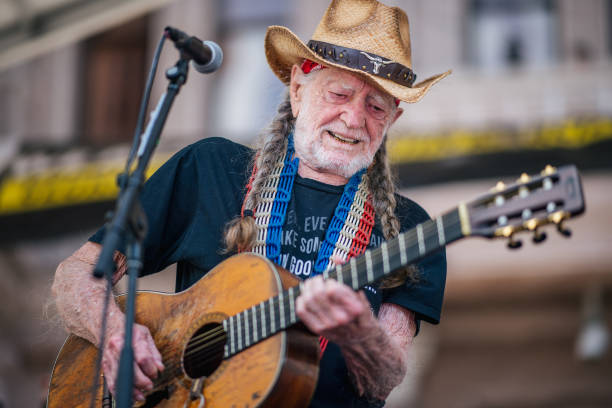
As twilight settled and visitors drifted toward food trucks, a low chorus rose from the crowd—“I’ll take you back to Texas”—followed by spontaneous applause. Some lingered at the statue, tracing the braids, snapping selfies, leaving flowers at the base. Others wandered down dim Main Street, passing the post office, the grain elevator, and the house where Willie once memorized multiplication tables between guitar rehearsals.
In bronze, he now stands watch: part guardian, part griot, all Texas. For Abbott, the monument isn’t merely an homage to fame; it’s a handshake across generations, a reminder that even giants start as small-town sons—proof that you can conquer the world and still come home for supper.


