

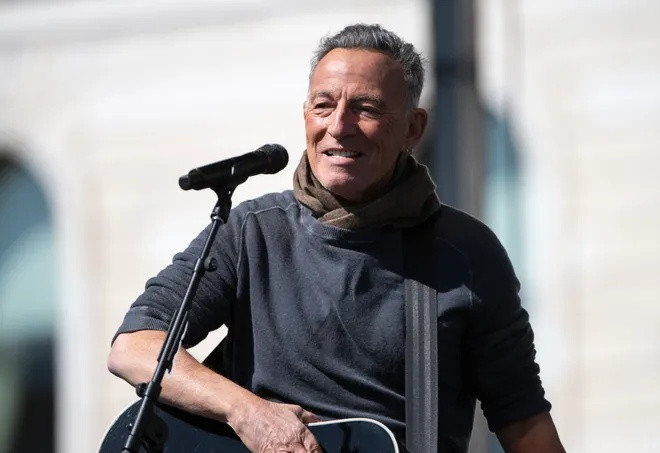
In a moment where music and politics collided on a national stage, Bruce Springsteen delivered both a performance and a message at the flagship "No Kings" rally in St. Paul, Minnesota, on March 28. The event, one of hundreds held across the United States, drew thousands of attendees united in opposition to the leadership of Donald Trump.
Springsteen, long known for giving voice to working-class America, took the stage not just as an artist—but as a participant in a broader cultural and political movement.
A Song Born from Protest
At the center of his appearance was a performance of his new protest song, "Streets of Minnesota," released earlier this year. The song reflects demonstrations that took place in response to immigration enforcement operations in the Twin Cities, which have sparked national debate.
Standing before a crowd gathered outside the Minnesota State Capitol, Springsteen introduced the song with a direct and emotional statement.
"This past winter, federal troops brought death and terror to the streets of Minneapolis," he said. "Well, they picked the wrong city."

His words were met with a mix of applause and solemn attention, as he pointed to what he described as the resilience and unity of the local community.
A Message of Resistance and Solidarity
Springsteen continued by emphasizing the role of collective action, framing the response in Minnesota as a symbol of broader national resistance.
"The power and the solidarity of the people of Minneapolis, of Minnesota, was an inspiration to the entire country," he told the crowd. "Your strength and your commitment told us that this is still America."
His remarks reflected a recurring theme in his recent work: the defense of democratic values and the rejection of policies he views as divisive.
"This reactionary nightmare and these invasions of American cities will not stand," he added, referencing immigration enforcement efforts across the country.
Remembering Lives Lost
During his speech, Springsteen also acknowledged individuals who died during recent confrontations involving federal agents, naming Renee Good and Alex Pretti.
"Their bravery, their sacrifice, and their names will not be forgotten," he said.
The moment shifted the tone of the rally, as the crowd listened in silence before the music resumed. As he began to play, Springsteen's performance took on a sharper edge—marked by intensity and emotional urgency.
At one point, he altered lyrics to include explicit criticism of political figures, underscoring the depth of his frustration.
A Stage Shared by Voices of Change
Springsteen's appearance was part of a broader lineup that included prominent figures from music, film, and politics.
Minnesota Governor Tim Walz introduced him with praise, highlighting his decades-long impact.
"He has spent a lifetime giving voice to the working class," Walz said. "We need no kings—but I'll tell you what we do need. We need a Boss."
Other notable participants included Joan Baez, Maggie Rogers, Jane Fonda, and Bernie Sanders.

Also making a surprise appearance was Tom Morello, known for his work with Rage Against the Machine and as a collaborator with the E Street Band.
Morello joined Baez and Rogers in a performance of The Times They Are A-Changin', adding another layer of historical resonance to the event.
A Movement Beyond One Stage
The St. Paul rally was just one of more than 3,000 "No Kings" events held nationwide that day, reflecting a coordinated effort to mobilize opposition and raise awareness around key political issues.
Springsteen's participation underscored the role of artists in shaping public discourse—not only through music, but through presence and voice.
Looking Ahead
Following the rally, Springsteen is set to continue his "Land of Hope and Dreams" American Tour, with upcoming performances expected to carry similar themes of reflection and engagement.
For many in attendance, the rally was more than a political gathering.
It was a moment where music became message—
and where one of America's most iconic voices used his platform to amplify both.
As the crowd dispersed, the echoes of guitar chords and spoken words lingered—reminding those present that, for Springsteen, the line between stage and society has never been clearly drawn. 🎸